Updated: May 2026
The Ultimate Komodo Private Dive Charter Route Guide
- Offers unparalleled flexibility to follow marine life and optimal tide conditions.
- Combines world-class diving with personalized overland excursions like trekking with dragons.
- Ensures privacy and luxury, avoiding the crowds of popular day-trip locations.
The hiss of the regulator is the only sound that breaks the deep, silent blue. Below, the reef slopes away into an abyss, a living tapestry of color and movement. A shadow detaches from the periphery, growing larger until it resolves into the unmistakable diamond shape of a reef manta, its five-meter wingspan propelling it with effortless grace. This is the essence of Komodo, but experienced from the deck of a private vessel, it transforms from a simple dive trip into a personal odyssey. You are not on a schedule; you are on an expedition, following the currents and the whispers of the sea, a privilege reserved for those who choose to chart their own course through this ancient archipelago.
Charting Your Course: The North vs. South Conundrum
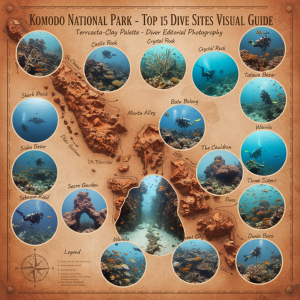
The first and most critical decision when planning your komodo private dive charter route is a matter of direction and season. Komodo National Park, a sprawling 1,733 square kilometer marine protected area, is a realm of two distinct personalities dictated by the monsoon winds. Understanding this duality is the key to unlocking its greatest treasures. From April through November, during the dry season, the compass points north. The seas are generally placid, the skies clear, and the water is a warm, inviting 27-29°C. Visibility can be extraordinary, often exceeding 30 meters, revealing vibrant hard coral gardens and staggering fish density. This is the Komodo of classic postcards, where legendary sites like Castle Rock and Crystal Rock attract immense schools of fusiliers, giant trevallies, and white-tip reef sharks.
Come December, the winds shift, and the savvy mariner turns south. While the rainy season brings afternoon showers to Labuan Bajo, the southern waters within the park’s embrace often become calmer. Here, the game changes entirely. The Indonesian Throughflow pulls cold, nutrient-rich water up from the deep, causing water temperatures to drop to a brisk 22-26°C. Visibility decreases to 15-20 meters, but what you lose in clarity, you gain in biomass. This southern upwelling creates a plankton-rich soup that attracts the ocean’s giants. This is manta ray territory. Sites like Manta Alley become cleaning stations for dozens of individuals, a spectacle that few other places on Earth can rival. A private charter provides the ultimate advantage here; as our dive guide, Anton, explained while we watched a dozen mantas circling below, “On a charter, we can stay for three dives if the show is good. We don’t have to leave for the next group.”
The Quintessential Northern Route (4 Days/3 Nights)
For those seeking classic, high-visibility reef diving, the northern route is the definitive choice. A typical four-day charter begins with a mid-morning departure from the bustling port of Labuan Bajo. Within two hours, you’re anchored off Sebayur Kecil for a checkout dive, reacquainting yourself with your gear amidst gentle slopes and friendly sea turtles. The first evening is spent under a canopy of stars, far from any shore-based light pollution. Day two is an immersion into Komodo’s high-voltage diving. You’ll head for Gili Lawa Laut, an island at the park’s northern tip. The main events are Castle Rock and Crystal Rock, two submerged pinnacles that act as magnets for pelagic life. These are current-swept dives, where you hook into the reef and watch the theater unfold: hunting sharks, barracuda vortexes, and fish schools so dense they block out the sun. The sheer biodiversity, part of why Komodo is a UNESCO World Heritage Site, is on full display.
Day three brings you into the park’s central corridor. The morning is dedicated to Batu Bolong, a rock pinnacle that erupts from the sea. Below the surface, it’s a protected cone of life, a veritable skyscraper of coral and fish that has been shielded from destructive fishing for decades. The density of anthias and damselfish is almost overwhelming. In the afternoon, you might dive Mawan, a sandy bottom frequented by mantas, before heading ashore to Padar Island. The 30-minute trek to its summit rewards you with the iconic view of three distinct bays, each with a different colored sand beach—a signature Komodo experience. On the final day, the itinerary balances wildlife above and below the water. A morning trek on Rinca Island offers near-guaranteed sightings of the formidable Komodo dragons in their natural habitat. After this prehistoric encounter, a final dive, perhaps at a macro site like Wainilu, provides a gentle comedown before the sail back to Labuan Bajo. This expertly paced journey is a perfect example of the voyages that a Komodo Divingtour Travel experience can deliver.
The Southern Manta Expedition (5 Days/4 Nights)
For the diver whose logbook is filled with dreams of large pelagics, the southern route is a pilgrimage. This itinerary requires a bit more time and a tolerance for cooler water, but the payoff is immense. Your charter will depart Labuan Bajo and make the longer sail south, often anchoring for the first night in the sheltered southern bays of Padar Island. The diving begins in earnest on day two in the formidable Horseshoe Bay of southern Rinca, a region known as Nusa Kode. Here, you’ll descend upon Cannibal Rock, a site legendary among macro photographers. The cold, green water fuels an explosion of life; the rock is covered in soft corals, tunicates, and sponges, providing a habitat for countless frogfish, nudibranchs, and pygmy seahorses. It feels like a different ocean entirely from the north.
The undisputed highlight comes on day three: a full day dedicated to Manta Alley. This channel between two rocky outcrops serves as a critical cleaning and feeding station for reef mantas (Mobula alfredi). On a good day, it is not an exaggeration to encounter 20 to 30 individuals. You can spend an entire dive hovering near a “cleaning station”—a coral bommie where cleaner wrasse service the gentle giants, who patiently queue for their turn. The sheer scale of the operation is hypnotic. The fourth day is a transition, moving north into the central park. You might experience a thrilling drift dive at Tatawa Besar, riding the current along a vibrant orange soft coral slope, before an afternoon of relaxation and snorkeling at the celebrated Pink Beach. The final day involves one last dive, perhaps at a site near Kanawa Island, before the return journey to Labuan Bajo, your memory cards and minds filled with images of soaring mantas.
The Art of Customization: Beyond the Standard Itinerary
The true value of a private charter lies in the word “private.” You are not beholden to a pre-written script. The route is a framework, not a set of rules. This is where you can tailor the voyage to your specific passions. For the dedicated underwater photographer, the itinerary can be re-engineered to maximize bottom time at world-class macro sites. Instead of a single dive at Wainilu, you could spend a whole day there, hunting for the rare hairy frogfish or blue-ringed octopus. Your private guide, an expert in critter-finding, becomes an invaluable asset. Our guide, Ismail, once spent 20 minutes patiently coaxing a shy mandarinfish from its coral hideout for the perfect shot—a luxury of time unthinkable on a standard trip.
For the adrenaline seeker, the charter can focus on Komodo’s most challenging, current-swept channels. Sites like “The Cauldron” (also known as Shotgun) between Gili Lawa Laut and Gili Lawa Darat offer a high-speed drift that is both exhilarating and demanding, requiring precise timing with the tides. A private charter captain has the flexibility to wait for the exact moment the current is running at its peak. For those seeking absolute solitude, a longer charter of 7 to 10 days can push the boundaries of the park, exploring the rarely visited western shores of Komodo Island or the Sape Strait. Crafting this kind of specialized journey is the hallmark of a premium komodo diving tour, transforming a great vacation into a once-in-a-lifetime expedition.
The Vessel Makes the Voyage: Selecting Your Liveaboard
Your vessel is more than just transportation; it is your hotel, your restaurant, and your dive center for the duration of the trip. The choice of liveaboard profoundly impacts the quality of your komodo private dive charter route. The most iconic option is the Phinisi, a traditional two-masted Indonesian sailing schooner. These magnificent wooden ships, often hand-built from ironwood and teak by the Konjo boat builders of Sulawesi, blend historic romance with modern luxury. A vessel like the 35-meter Amandira or the 50-meter Prana by Atzaró offers expansive decks, private en-suite cabins, and a level of service that rivals a boutique hotel. A crew-to-guest ratio of 1:1 is not uncommon on these top-tier charters, ensuring every need is anticipated.
When evaluating a charter vessel, look beyond the aesthetics. For divers, the functional aspects are paramount. Is there a dedicated, climate-controlled camera room with ample charging stations? Is Nitrox available, and is it included in the price? (Given the 3-4 dives per day schedule, Nitrox is highly recommended to extend bottom time and reduce fatigue.) How experienced is the crew, particularly the captain and dive guides? Their local knowledge of Komodo’s notoriously tricky currents is your most important safety feature. Finally, inspect the dive tenders. Are they spacious, sturdy zodiacs with powerful engines, capable of quick pickups in strong currents? The cost of a private charter can range from $5,000 to over $20,000 per day for the entire vessel, so due diligence is essential. This investment secures not just a boat, but a professionally managed platform for exploration.
Quick FAQ on Planning Your Komodo Charter
What is the absolute best time of year for a komodo private dive charter route?
There are two “best” seasons. For warm water, exceptional visibility, and classic northern reef diving, aim for April to November. For the peak manta ray aggregation in the south, brave the rainier season from December to March. A charter in a shoulder month like April or November could potentially offer a taste of both.
How much diving experience is truly necessary?
We strongly recommend an Advanced Open Water certification with a minimum of 50 logged dives, including experience in strong currents. Komodo is not a beginner’s destination. The currents can be powerful and unpredictable, and a solid foundation of skills is crucial for both safety and enjoyment. Your charter operator will vet your experience before confirming a booking.
What is typically included in the charter price?
Inclusions are generally comprehensive: the vessel and crew, all meals and snacks, non-alcoholic beverages, and all diving activities (tanks, weights, guides). Key exclusions to budget for are Komodo National Park fees (which can be up to IDR 500,000 per person, per day for foreigners), dive gear rental, Nitrox fills, alcohol, and crew gratuity. A tip of 10-15% of the charter fee is customary for excellent service.
Can non-divers enjoy a private charter in Komodo?
Absolutely. The beauty of a private charter is its flexibility. The itinerary can be heavily weighted towards non-diving activities. Days can be filled with snorkeling on pristine reefs, kayaking through mangrove forests, trekking on Padar and Rinca, visiting Pink Beach, and enjoying sunset cocktails from a secluded anchorage. The dramatic, savannah-like landscapes of the islands are a spectacle in themselves.
A private charter in Komodo is the ultimate expression of freedom in one of the world’s last great wild places. It’s an opportunity to move with the rhythm of the tides, not the hands of a clock. It’s about following a pod of dolphins on a whim, or spending an entire afternoon with a squadron of manta rays because you simply can’t tear yourself away. This is not just a trip; it is your personal map to the heart of the Coral Triangle. Ready to draw the lines on your own chart? The experts at Komodo Divingtour Travel are standing by to help you craft the perfect komodo diving tour and launch an unforgettable voyage.