Updated: May 2026
The Best Luxury Komodo Dive Sites for Advanced Divers
- Exceptional biodiversity, from macro critters to large pelagic species.
- Demanding conditions that require advanced certification and experience.
- Luxury access ensuring expert private guides and uncrowded dive profiles.
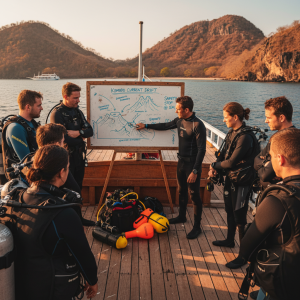
The low hum of the ironwood phinisi is the only sound that breaks the morning stillness. You are anchored in a turquoise channel, flanked by a diorama of scorched, dragon-backed islands. The air, thick with salt and the scent of dry earth, is still cool. Below the placid surface, however, an entirely different world is moving at speed. This is Komodo, and for the advanced diver, it represents not a tranquil aquarium but a grand, untamed aquatic safari. It’s a place where the ocean’s power is on full display, and navigating its currents is the price of admission to some of the most vibrant and densely populated underwater real estate on the planet. Forget what you know about casual resort diving; this is an expedition. And for those who demand the pinnacle of both adventure and comfort, there is no better theater of operations.
Batu Bolong: The Overcrowded Classic, Perfected
Every diver who has researched Komodo knows of Batu Bolong. It’s the poster child, a small, unassuming rock breaking the surface between Tatawa Besar and Komodo Island that hides a staggering concentration of life. The name translates to “Hollow Rock,” and its sheer walls plummet well past 40 meters. The challenge, and the very reason for its vitality, is the current. It splits around this pinnacle, creating a protected lee side where marine life flourishes in a kaleidoscopic frenzy. The typical day-boat itinerary means arriving here mid-morning, jostling for position with a dozen other vessels. This is not our way. Aboard a private charter, the schedule is dictated by the tides, not a timetable. Our guide, a Flores veteran with over 5,000 dives in these waters, insisted on a dawn entry. At 7:00 AM, with the sun just beginning to burn off the morning haze, we were the only ones there. The experience was transformative. Descending on the protected south side, we were met not by other divers’ bubbles, but by a wall of schooling fusiliers so thick it momentarily blocked the light. Enormous Napoleon wrasse, some easily 1.5 meters long, patrolled the reef crest, while white-tip reef sharks rested on sandy ledges below. The sheer density is what one remembers—every square centimeter is colonized by hard and soft corals, anemones, and crinoids. It’s a testament to the park’s status as a UNESCO World Heritage Site, a designation it has held since 1991.
The Cauldron and The Shotgun: A Lesson in Hydrodynamics
For the adrenaline-inclined, few dives in the world can match the sheer velocity of The Cauldron, also known as Shotgun. Located in the narrow channel between Gili Lawa Laut and Gili Lawa Darat, this site is a masterclass in fluid dynamics. The dive begins in a calm, bowl-shaped area—”the cauldron”—replete with coral gardens and cruising manta rays that often use the area as a cleaning station. We spent a good 20 minutes here with a squadron of five reef mantas, their 4-meter wingspans casting shadows over the reef. But this is merely the overture. The dive plan, as explained by our divemaster, is precise. As the tide rushes through the channel, it accelerates through a narrow gap, creating the “shotgun.” On his signal, we streamlined our bodies, tucked our gear, and entered the flow. The feeling is less like swimming and more like flight. For roughly 90 seconds, you are propelled at speeds that can exceed six knots through a canyon of rock. The key is control; small fin movements allow you to navigate, but you are largely a passenger on this underwater expressway. The rush is immense. You are spat out into a serene coral garden on the other side, where large schools of sweetlips and snapper congregate, seemingly unfazed by the torrent just meters away. This is a dive that requires absolute confidence in your skills and your guide. It’s the kind of high-stakes, high-reward experience that defines the advanced itineraries on our PADI & SSI day trips.
Castle Rock: The Pelagic Amphitheater
If Batu Bolong is a condensed metropolis of reef fish, Castle Rock is the grand stage for Komodo’s pelagic predators. This submerged seamount, located north of Gili Lawa Laut, rises from depths of over 70 meters to within 4 meters of the surface. Its exposed position makes it a magnet for currents and, consequently, for the big fish that hunt in them. This is not a dive for the faint of heart or the inexperienced. The descent is often a negative entry into a formidable current, dropping quickly to around 25 meters to find shelter behind a large rock formation. Once in position, you hook into the reef with a current hook, inflate your BCD just enough to be neutral, and simply watch the show unfold. Within minutes, we were surrounded. A consortium of giant trevally, each the size of a car tire, swirled in a vortex just off the pinnacle. Gray reef sharks and white-tips patrolled the perimeter with an unnerving calm. A lone eagle ray soared past. The sheer number of sharks—we counted at least a dozen in our field of vision at one point—is a powerful indicator of a healthy marine ecosystem, a core tenet of the Coral Triangle, which Indonesia is the heart of. The safety stop itself is an event, performed as a blue-water drift, often accompanied by curious batfish. A private komodo diving tour allows the flexibility to dive Castle Rock at its peak, when the currents are running strong and the action is at its most intense.
Crystal Rock: A Soft Coral Counterpoint
Often dived in the same sequence as Castle Rock, Crystal Rock offers a different, though equally compelling, experience. This pinnacle, which breaks the surface at low tide, is renowned for the clarity of its water and its spectacular soft coral coverage. While the currents can be just as demanding, the topography provides more shelter, allowing for a more exploratory dive profile. We descended on the split point, watching the water accelerate around the rock, and then tucked into the lee side. The explosion of color was immediate. Vast fields of orange and yellow soft corals blanketed the rock faces, pulsating gently in the surge. Hiding amongst them were frogfish, scorpionfish, and a host of nudibranchs, making it a superb macro photography site. But the big animals are never far away. As we rounded a corner, we came face-to-face with a school of surgeonfish numbering in the thousands, moving as a single, shimmering entity. A few minutes later, a school of large dogtooth tuna powered through the blue. The highlight was the summit; at around 5 meters, the rock is covered in a dense carpet of anemones, their resident clownfish darting in and out. It’s a site that perfectly marries the macro with the megafauna, a hallmark of the diving throughout the Indonesian archipelago. The ability to properly explore sites like this, without being rushed, is a core benefit of the curated 3-day dive safaris we specialize in.
Manta Point: A Private Audience with Gentle Giants
Makassar Reef, more famously known as Manta Point, is a vast, rubble-strewn slope that, at first glance, appears somewhat barren. It lacks the dramatic topography of the northern pinnacles. But this underwater plain serves a vital purpose: it is one of the most reliable manta ray cleaning stations in the world. The challenge here isn’t current, but patience and etiquette. The site can become extremely crowded. The luxury approach is to arrive when others are leaving. Our skipper positioned our vessel up-current in the late afternoon, allowing us to drift slowly over the entire 2-kilometer-long site. For the first ten minutes, we saw nothing. Then, a shadow emerged from the periphery. It was a massive oceanic manta, its wingspan easily exceeding 5 meters, followed by two smaller reef mantas. We hovered neutrally, staying low to the substrate, and simply observed. They circled a particular coral bommie, allowing wrasse and other cleaner fish to remove parasites from their skin and gills. For over 40 minutes, we were treated to a private ballet, with up to eight individuals gliding, circling, and somersaulting around us. It was a profound, almost spiritual encounter, made possible by avoiding the midday rush. This is the essence of a luxury dive experience—it’s not just about what you see, but how you see it.
Quick FAQ for the Discerning Diver
What certification and experience are truly required for these sites?
An Advanced Open Water certification is the absolute minimum. However, we strongly recommend at least 50 logged dives, with documented experience in strong currents and drift diving. Confidence and calm buoyancy are non-negotiable.
When is the optimal season for a luxury Komodo dive trip?
The primary dive season runs from April through November, offering the best combination of calm surface conditions and excellent visibility. However, diving is possible year-round. The “rainy” season from December to March often brings greener water but also higher concentrations of manta rays in the central and southern areas.
Is Nitrox essential for diving in Komodo?
While not mandatory, it is highly recommended. Given the multi-dive days and the square profiles of many pinnacle dives, using Enriched Air Nitrox (typically 32%) significantly extends your no-decompression limits, reduces surface intervals, and mitigates fatigue, allowing you to get the most out of your expedition.
How critical is a private guide and charter?
For advanced sites, it is the difference between a good dive and an extraordinary one. A private guide who knows the tides intimately can get you to sites like Batu Bolong or The Cauldron at the precise moment for optimal conditions and minimal traffic. It elevates the entire experience from a tour to a bespoke adventure, which is the philosophy behind all our Komodo Diving Tour Voyages.
Komodo’s currents are the lifeblood of its unparalleled marine biodiversity. They are not an obstacle to be overcome, but a force to be understood and respected. For the advanced diver, they are the engine of an unforgettable adventure. To experience these sites properly is to move beyond the standard day-trip circuit and embrace an itinerary built around tidal charts and animal behavior, not the clock. It requires a vessel capable of providing comfort and a crew that provides impeccable, intuitive service. This is the ultimate underwater wilderness, and it demands an approach to match. Ready to book your own bespoke komodo diving tour and witness this majesty for yourself?