Updated: May 2026
Castle Rock vs Crystal Rock | Honest Komodo Dive Site Comparison
Komodo Diving Tour is a curated Indonesia luxury tourism experience offered by Komodo Divingtour Travel: handpicked routes, vetted operators, transparent pricing, and 24/7 concierge support across Indonesia.
- What makes Komodo Diving Tour a premium experience.
- How Komodo Divingtour Travel curates exclusive access and concierge logistics.
- Routes, seasons, and pricing transparency — no hidden fees.
Castle Rock vs Crystal Rock: An Honest Komodo Dive Site Comparison
What Is the Difference Between Castle Rock and Crystal Rock?
Castle Rock and Crystal Rock are sister submerged seamounts in the central Komodo National Park, both north of Gili Lawa Laut, separated by 800 metres of channel, but they differ materially in current strength, depth profile, certification requirement and the species you can expect to see on a typical dive. Castle Rock is the harder dive: deeper, faster current, sharks-and-trevally focused, requires a 50-dive logbook and a current hook. Crystal Rock is the gentler dive: shallower, slower current, soft-coral and bigeye-trevally focused, accessible to Open Water divers with 25 logged dives. They are best dived back-to-back on the same morning during the rising tide, Castle Rock first at slack water, Crystal Rock second once the current builds. This guide compares the two sites on the seven dimensions that actually matter to a diver planning a Komodo trip.
Depth Profile
Castle Rock peaks at 5 metres below the surface and drops to 35 metres on the southern face, with the cleaning station at 18 to 22 metres being the typical anchor point for current-hook diving. The northern face descends past 50 metres for those with technical training but recreational dives stay above 30 metres on Nitrox 32 and above 25 metres on air. Crystal Rock peaks at 3 metres and drops to 25 metres, with the bigeye trevally school cycling tight at 12 metres exactly. The shallow profile means Crystal is easier on no-decompression limits and gives a longer bottom time of 60 to 70 minutes versus 45 to 55 minutes at Castle.
Current Strength and Direction
Castle Rock current is rated 3 to 5 on our 5-point scale, with peak flow during the strong tidal exchange windows of new moon and full moon. The current direction varies but typically runs west-to-east on the rising tide and east-to-west on the falling tide. The site is famous for downcurrents on the western face when the tidal flow accelerates, which is why we time our entry for slack water and ascend on the eastern face once the current builds. Crystal Rock current is rated 2 to 4, with the same west-east cycle but at materially lower peak speed. Crystal does not develop the dangerous downcurrents that Castle does, which is the primary reason it is accessible to less-experienced divers.
Visibility and Water Temperature
Castle Rock visibility is honestly 20 to 30 metres in the dry season April to October, dropping to 15 to 25 metres in the wet season. Water temperature 26 to 29 degrees Celsius. Crystal Rock visibility is 15 to 25 metres year-round and water temperature is consistent with Castle. Both sites benefit from the warm Indian Ocean current and neither requires more than a 3mm full-length wetsuit for comfort during the 50 to 60 minute dives.
Marine Life: Castle Rock
Castle Rock is the headline shark-and-trevally dive of central Komodo. The cleaning station at 18 to 22 metres hosts 5 to 15 grey reef sharks during peak season April to October, with whitetip reef sharks resident year-round. The famous tornado of giant trevally and dogtooth tuna that materializes at slack tide is the photographic highlight: schools of 100-plus fish circling the seamount in tight spiral formation. Other regulars include schooling jacks, batfish, snapper, and the occasional eagle ray on the deeper southern face. Hammerheads have been logged at Castle in the early dry season May to June, but they are not a reliable encounter and we do not advertise them.
Marine Life: Crystal Rock
Crystal Rock is the soft-coral and reef-fish dive. The bigeye trevally school at 12 metres is the photographic highlight: a shimmering wall of 200-plus fish that the photo guides love because they cycle predictably and let you frame the shot at f/8 with the seamount as backdrop. Soft coral cover on Crystal is documented at 70 percent versus 50 percent at Castle, making it the more colourful of the two for wide-angle photography. Reef sharks pass occasionally but they are not the headline act. Other regulars include sweetlips, schooling fusiliers, hawksbill turtles and the resident map puffer pair that the guides have been counting since 2018.
Certification and Experience Requirement
Castle Rock requires Advanced Open Water with 50 logged dives, drift specialty preferred, and a current hook is mandatory for divers wanting to anchor at the cleaning station. We do not allow divers with fewer than 50 logged dives to attempt Castle at peak tide, full stop. Crystal Rock requires Open Water with 25 logged dives. Drift specialty is recommended but not mandatory. The shallower profile and slower current make Crystal a reasonable second dive after Castle, or a primary dive for less-experienced divers in the same group as Castle-bound advanced divers.
Photography Considerations
Castle Rock favours wide-angle with strobes for the shark-and-trevally action at the cleaning station, plus a fast shutter at 1/250 to freeze the trevally tornado. The current means buoyancy and stability are challenging, so we recommend a current hook and a static-platform strategy rather than a roving photo-tour. Crystal Rock favours both wide-angle for the soft-coral and trevally school, plus macro on the seamount face for the hairy crab, soft-coral pygmy and the occasional pipefish. The slower current makes Crystal materially easier for serious photographers.
Which Should You Dive First?
If conditions permit, dive Castle Rock first at the slack-tide window, ascend with current hook deployed, and surface for a 60-minute interval. Then dive Crystal Rock second once the current builds. This sequence respects no-decompression limits and matches your fatigue level to the dive complexity. If conditions favour the falling tide instead, we may flip the sequence, but the principle holds: harder dive first, easier dive second. If you have only one tank to spend, dive Castle Rock at slack water with a 1-to-3 guide ratio. The shark-and-trevally action is what people fly to Komodo for.
Common Mistakes to Avoid
The three most common mistakes we see at Castle and Crystal: divers under-weighting and missing the negative-entry, divers ignoring the SMB-deployment-from-depth protocol on safety stop, and divers attempting Castle at peak tide without a current hook. The first two are recoverable with a competent guide. The third is what fills our incident-debrief paperwork.
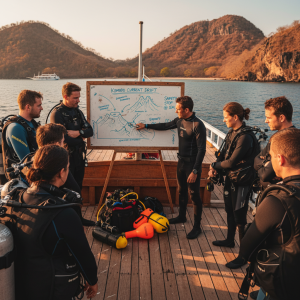
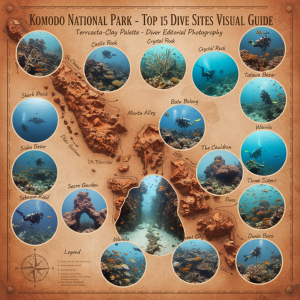
For more on dive sites across the park see our guide to Komodo’s top 15 dive sites. For current technique and safety see our Diver’s Guide to Komodo Currents. For tier comparison and pricing, see our Komodo Diving Tour package page.
Book your Castle and Crystal dive day. Email bd@juaraholding.com or WhatsApp +62 811 3941 4563 with your dates, certification and dive count. We will time your slot to slack water for the optimal Castle-Crystal sequence.